Extraordinary women
This exhibition is part of a transformative research program called RE-WIRING, funded by the European Union. In addition to the University of Deusto, it is organized in collaboration with other prominent institutions, including the University of Portsmouth (UK), Center for Inclusive Leadership (GB), University of Western Cape (South Africa), University of Utrecht (Netherlands), and University of Gdańsk (Poland).
Each of these countries hosts an exhibition on power hierarchies with a gender perspective to prevent and reverse inequalities, catalyze processes of change, and actively involve people and groups. We work to “re-connect” institutions, problems, and people, creating changes that prevent and reverse inequalities. The exhibition is intended to reach all audiences.
The title is a tribute to the productive role of women. With the words –ezhoiko (extraordinary in Basque) / (ez)οικο (domestic economy in Greek) – we connect with antiquity. In the Greek oikos – not only a family unit but also an economic unit – women were responsible for managing domestic affairs, including textile production, and for ensuring the family’s well-being. Women had influence within the home, especially if their husbands were absent, but not outside it. In Roman domus, women also managed domestic affairs, supervising tasks related to care, education, food preparation, and sometimes family finances. However, they remained restricted to the private sphere and had limited legal rights. The Roman presence in Gipuzkoa (Basque Country) focused on the important port and mining area of the Bidasoa estuary, with settlements and additional remains along the coast and southern routes, although the region was not systematically colonized. Since then, and especially during the Industrial Revolution, women had a role in the extraordinary economic development of this rich European region, which has been systematically invisibilized.
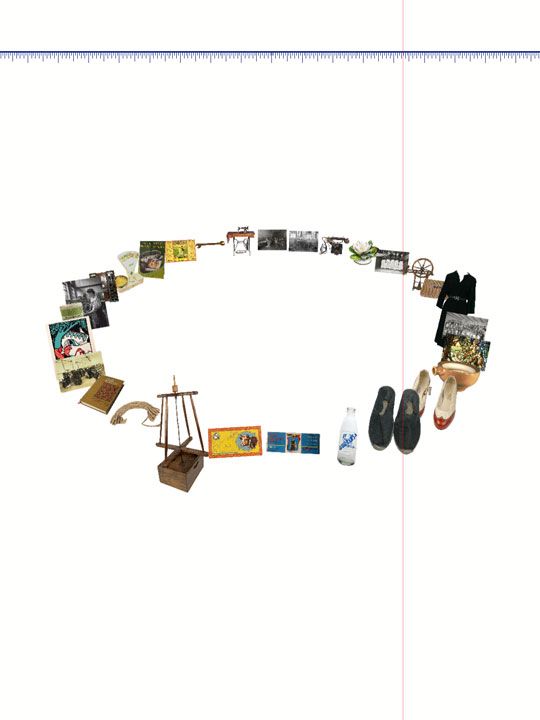
From this starting point, the exhibition addresses the place occupied by women in the economy of Gipuzkoa – in sectors such as fishing, textile industry, porcelain, glass, and food – through pieces and photographs that, for their artisanal and artistic value, have been gathered in the Gipuzkoa Heritage Collections Center (GORDAILUA), San Telmo Museoa (STM), and Kutxa Fundazioa. They are shown to the public in a collection organized around an alphabet, which brings the reality, past, and diversity of working women closer to the audience.
The exhibition expands the concept of work to include the realm of care. This space is not represented by any object, precisely to highlight the difficulty of identifying it as work. It belongs to the reproductive sphere and is, by nature, attributed to women. The exhibition is also a dichotomy between paid-productive work (a space of inequality where women’s labor has not been recognized) and unpaid-reproductive work (a feminized space that, although necessary for productive development, remains a major unresolved issue in our society). This conflict is addressed with the audiovisual work “Porfa, un favor” by Irati Cano Alkain, created specifically for this project.
It is not EXTRAORDINARY that women worked, but it is EXTRAORDINARY to give them visibility and recognize their place in industrial and economic history, in the artistic and cultural pieces rescued and preserved to promote a society where productive and reproductive work is equally visible, valued, and assumed by men and women.
The project includes a test exercise to understand what we call and understand as paid and unpaid work, as well as the shared responsibility we take regarding both concepts in our lives and the temporal load that entails.
The audiovisual artist Irati Cano Alkain created an audiovisual work reflecting on future work and artificial intelligence in care networks.